Here’s how to inject antiscalant:
- In RO systems, the injection point of the antiscalant is located before the micron filter or cartridge filter.
- That is, after sand filter and carbon filter
Advantages of antiscalant injection in RO
- Extends the lifespan of cartridge filters and membrane filters.
- Prevents the formation of sediments in the membrane filter
What is antiscalant?
Descaler (also: limescale remover) is a chemical cleaning agent used to remove limescale deposits. At home, acetic acid, citric acid, and sulfamic acid, as well as products containing these substances, are used.
Limescale formation
Limescale (CaCO3 , formed from Ca2 + and CO32- ) is produced from tap water at high temperatures (e.g., in a kettle). Calcium bicarbonate, readily soluble in water (Ca(HCO3 ) 2) in tap water, transforms into water-insoluble limescale (chemical name: calcium carbonate), which deposits on the walls or heating elements of a gas stove and increasingly prevents heat transfer.
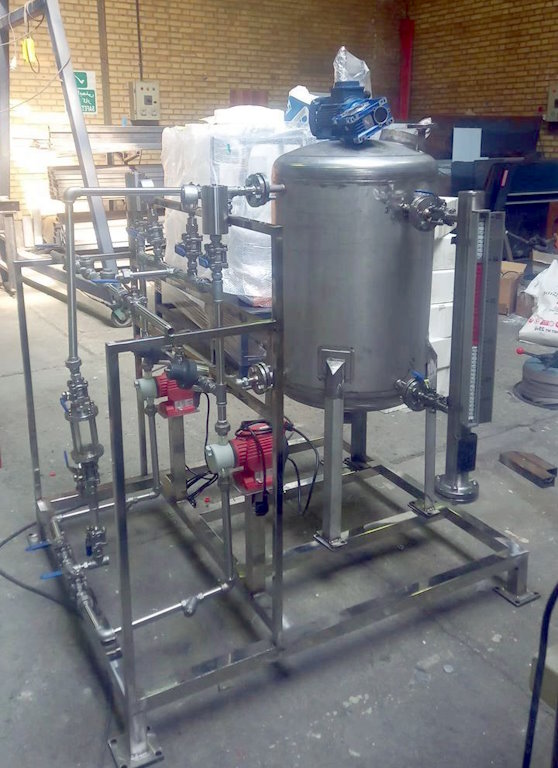
Descaling
The addition of acid increases the solubility of CaCO3 . Protonated water molecules (oxonium ions, H3O + ) in acidic solution donate protons to carbonate ions (CO32- ) . This then reacts again to form carbonic acid ( H2CO3), which immediately decomposes into water ( H2O) and gaseous carbon dioxide (CO2 ) . Calcium ions (Ca2 + ) combine with the anion of the acid used to form a water-soluble salt.
reaction equation
Dissolve lime with acetic acid:
- 2 CCH3COOH+CACO3⟶Cia (aq)2++2 CCH3COO (aq)-+CO2+H2O

Therefore, acetic acid reacts with insoluble lime (CaCO3 ) to form water-soluble calcium acetate [which decomposes into calcium ions (Ca2 + ) and acetate ions (H3C – CO2- ) ] . Gaseous carbon dioxide is released in the process, and it foams.
Dissolve lime with citric acid:
- 2C6H8O7+3CaCO3⟶3H2O+3CO2+2C6H5O73-+3Approximately 2+

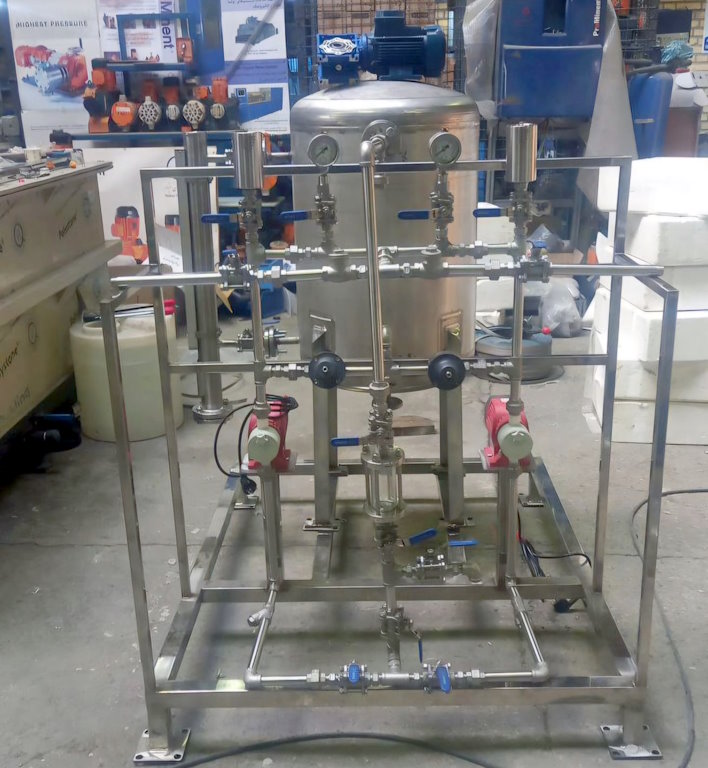
Types of sediment removers in Iran
Different limescale removers are used depending on the application or device.
Acetic acid can attack metals and damage seals and should therefore only be used for descaling appliances made entirely of stainless steel or other acid-resistant materials and when seals are readily available.
When using citric acid, appliances that heat water (coffee makers, kettles, etc.) should not be switched on. Although heated acid dissolves limescale more quickly, heat causes the remaining limescale to redeposit and can lead to stubborn deposits and blockages. For this reason, coffee machine cleaning tablets often contain lactic acid.
Corrosion problems or stubborn deposits do not typically occur with sulfamic acid. Therefore, it is used in most commercially available descaling materials, which have a wide range of applications.
Limescale deposits on vertical surfaces such as shower walls can be removed by washing toilet paper (or other soft, absorbent material) with acid, e.g., soapy water. Alternatively, soak the paper in essential oils of vinegar and apply it to the surfaces to be descaled. For heavier deposits, leave the soaked paste on the surface for several hours or days and re-wette it with water or acid as needed ; concentrated acids can also be used. Wear gloves and safety goggles when using this method.
Despite the advertising claims of limescale remover manufacturers, washing machines and dishwashers generally do not need descaling, as the detergents used contain sufficient water softeners to prevent limescale deposits even with insufficient dosage. Too little detergent initially leads to so-called ” grease spots” (small, gray, greasy stains of limescale soap) before the limescale builds up on the heating elements.